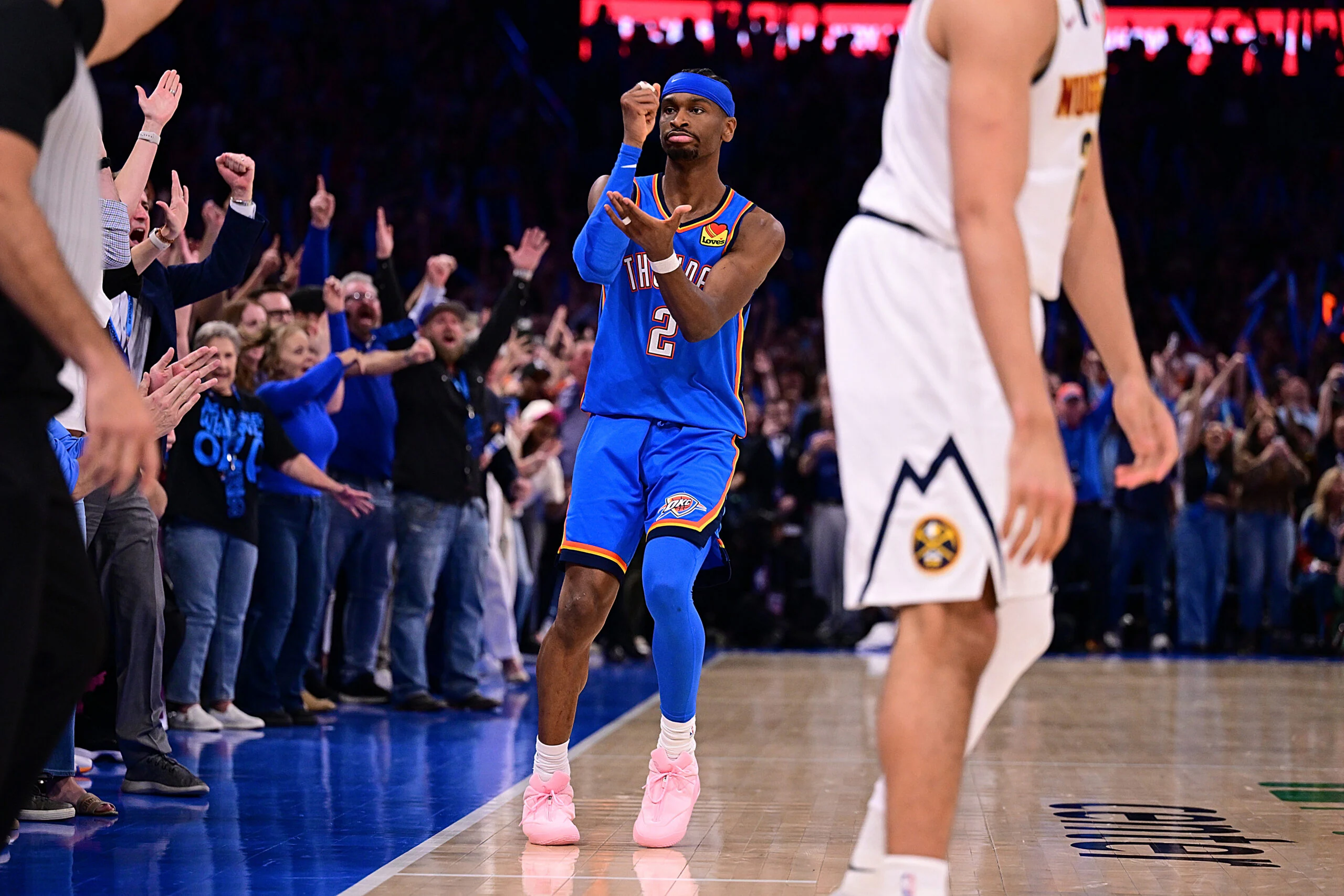

Shai Gilgeous-Alexander can break Wilt Chamberlain’s record for consecutive 20-point games with a strong performance Thursday against the Boston Celtics.
Editor’s Note: Read more NBA coverage from The Athletic here. The views on this page do not necessarily reflect the views of the NBA or its teams.
***
OKLAHOMA CITY — Shai Gilgeous-Alexander’s current run is testing his tunnel vision.
He’s racked up trophies with the Oklahoma City Thunder. Four NBA All-Star selections. Three first-team All-NBA selections. A scoring title. NBA Finals MVP. League MVP — and likely on the verge of another during an undeniable run.
A decorated window for a composed superstar who feigns indifference. One on the verge of crystallizing an all-time ascension.
His climb hit like a crash test, same as his latest historical streak. The burden now is being in the same statistical breath as a legend whose legacy is defined by impossible numbers.
On Thursday night against the Boston Celtics, Gilgeous-Alexander can surpass a 63-year-old Wilt Chamberlain record: His streak of consecutive games with 20 points or more can extend to 127 games, best in NBA history.
“It’s still a lot to even wrap my head around,” Gilgeous-Alexander said Monday night after tying the streak. “To be honest with you, I try not to even think about it, especially during the season. So much is going on, and so many things have to go right for you to get what you ultimately want.
“But obviously being in the conversation with a guy like (Chamberlain) is special.”
Gilgeous-Alexander has authored this storyline for 496 days. Repeatedly offering 30-pieces until they became his bare minimum. Virtually no one knew the names he’d leapfrog, or the record he unconsciously chased while floating toward 20 points nightly. Consistency morphed into his tagline. Zooming out, he’s signified a redefinition of what it means in the NBA.
But consistency to this degree can feel difficult to measure. His averages don’t detail the extent of his ease. In an era of nauseating pace and mind-boggling offense, Gilgeous-Alexander has equally distanced himself from a 70-point game as he has a single-digit outing. In these past 126 games, Gilgeous-Alexander has only scored 21 points or fewer a mere five times. As if teetering toward the teens is beneath him.
“He’s just been out of this world the past four or five years, especially scoring the ball,” Houston Rockets All-Star Kevin Durant said Tuesday night. “I think he’s averaging 30 (points) over the last four years. I love players who care about leaving their mark in the history books. You can tell Shai cares about it. Obviously, he’s a team-first player. But you can tell he wants to be great.
“He wants to be considered one of the greatest of all time.”
Shai Gilgeous-Alexander is averaging 31.7 points per game this season and hasn’t scored fewer than 20 points since October of 2024.
To understand the magnitude of Gilgeous-Alexander’s run, you need to grasp the dominance of a giant whose greatest feats took on lives of their own, most of them written off as inaccessible. More than half a century removed from his reign, Chamberlain exists primarily as a myth. His 100-point game elicits conspiracy theories. His 50-point single-season average evokes head shakes of disbelief.
His physical description, from those left to accurately depict it, is folklorish. He endures as an idea, an impossible 7-footer who was quicker and stronger than a storyteller’s imagination can perceive.
Chamberlain’s records from his Hall of Fame NBA career almost all remain untouchable. All but one, a streak of proportions previously so far-fetched that it wasn’t dusted off until Gilgeous-Alexander threatened it.
On Jan. 20, 1963, Chamberlain’s 126-game streak of consecutive 20-point games snapped in St. Louis. It’s not that he suddenly became incapable of sleepwalking to 20 points. Rookie official Leo “Red” Oates altered history.
Rookie forward Wayne Hightower — who trailed Chamberlain at Overbrook High School in Philadelphia, then the University of Kansas, then as a member of the San Francisco Warriors — was whistled for an early foul. Chamberlain, at Hightower’s defense, barked at Oates. The first technical didn’t stop him.
Four minutes into what ultimately became a 116-115 Warriors loss, Chamberlain was ejected, believed to be the only such instance in his 14-year career. He left with six points and one rebound.
“He must have had a real big beef, Wilt, because he never got thrown out of a game, and he never argued with officials,” 87-year-old Tom Meschery told The Athletic in an exclusive interview. Meschery played 21 minutes that night and started beside Chamberlain for several seasons.
“Believe me,” Meschery said, “people beat up on him more than anybody I’ve ever seen — except maybe Stephen Curry. He never gets a damn call.”
The image plastered in the sports section of the San Francisco Examiner the following morning showed Chamberlain hunched over, hands draping above his kneecaps and knee-high socks, towering over Oates. “The Ref Scores,” the subhead read. Chamberlain would’ve otherwise.
“The ejection of Chamberlain got major attention,” Oates recalled to the Milford Daily News in 2005. “I started by hitting Wayne Hightower with a pair of technicals, then Wilt got involved and started swearing. He had a technical, and I called another, and he was out.”
He added: “The commissioner reminded me that 14,000 fans had come out to see Wilt. After the ejection, Wilt and I got along fine.”
Chamberlain entered that night averaging 47 points, a season removed from averaging 50.4 points. His run of consecutive 20-point games lasted 457 days. He averaged 16.3 free-throw attempts and shot 51.1 percent from the field.
The 3-point line was 17 seasons away from its NBA introduction. Nine teams existed in the NBA after welcoming the Chicago Packers that year. Dolph Schayes topped the NBA’s all-time leading scorers with 18,304 points.
One month later, Chamberlain’s rule resumed. From Feb. 26, 1963, to March 18, 1964, Chamberlain produced a 92-game stretch of consecutive 20-point games that long held second place — until Gilgeous-Alexander came along.
In both the 1962-63 and 1963-64 seasons, Chamberlain played full seasons of 80 games apiece, averaging 47.6 and 46.1 minutes, respectively. A different world, a different game. By all accounts, Chamberlain’s motor never stalled.
“He was never tired,” Meschery said. “I mean, he was a mammoth, physical presence and a physical strength. It has a lot to do with it, probably. You know that he picked up Arnold Schwarzenegger with one arm, don’t you?”
Added Meschery, who was 6-foot-6 and 215 pounds in his heyday: “He picked me up by one arm, too. One time, I was going to get into a fight with a guy named Gus Johnson in Baltimore. Wilt saved my life by picking me up and carrying me away.”
The average NBA height in Chamberlain’s day was 6-6. The average mark in Gilgeous-Alexander’s NBA is 6-7, though the greatest rim protector of his era is listed at 7-4 and would be as difficult to explain as Chamberlain if not for the internet. It’s tough to explain with it.
Chamberlain’s nicknames sound as fittingly hyperbolic as the recollections of him. The Big Dipper. Goliath. Wilt the Stilt, a moniker he despised.
“He had such long arms, such long legs,” Meschery said. “His athleticism was quite good. … He could run the 600 meters; he did that in college. He could high jump. I don’t think there’s ever been an overall athlete like him, ever.
“He was a constant presence on the court. You couldn’t avoid him. There was no way that you could not pass him the ball if he was open.”
On March 2, 1962, Chamberlain famously scored 100 points in a 169-147 win over the New York Knicks in Hershey, Pennsylvania — a game at the center of conspiracy theories in the absence of footage. Meschery remembers the big man requesting a substitution that night. But Frank McGuire, the Warriors’ coach for that lone 1961-62 season, refused. McGuire eyed history, so the Warriors shoveled to Chamberlain more than usual.
“By the time we got to the point where Wilt was within 10 points,” Meschery recalled, “I was already on the bench, Paul (Arizin) was on the bench. We had (Joe) Ruklick and a few of the other guys in there that just bumped the ball to Wilt.
“Once McGuire said, ‘No, you’re staying in,’ Wilt just thought, ‘OK, the door’s open, I’m going to walk through.’”
Wilt Chamberlain (13), playing with the Philadelphia Warriors in the early 1960s, made history by scoring 20 points or more in 126 consecutive games. Bettman
Chamberlain’s constituents describe an athlete so formidable that he grew immune to schemes. Sonny Hill, an 89-year-old Philadelphia basketball legend who founded an eponymous league and serves as an adviser for the 76ers, was linked to Chamberlain dating back to their high school days.
He remembers Boston Celtics coach Red Auerbach finding short-lived ways to keep Chamberlain behind plays.
“What he would do,” Hill recalled, “he would have Tommy Heinsohn step in front of Wilt so Wilt could not get back down the floor. And they did that for a period of time. … It worked up until the point that Wilt got upset. Tommy Heinsohn did it one time, and Wilt picked him up off the floor.”
“You would have to see it to believe it, because if somebody is telling you, it’s unbelievable.”
Chamberlain lived almost exclusively near the rim and excessively at the free-throw line — which makes his new link to a 6-6 Canadian ballhandler all the more striking.
The big fella wasn’t a stellar foul shooter. Gilgeous-Alexander’s worst season of his past four from the free-throw line came in 2023-24, only his second year as an All-Star, when he shot 87.4 percent on 8.7 attempts — less than half as many average attempts as Chamberlain averaged during his streak.
“My grandson criticizes Shai because he says that Shai seeks out fouls, that he’s the guy who’s looking to get fouled and to get to the line,” Meschery said. “I know players who have always done that. In my era of Frank Ramsey, John Havlicek, Sam Jones, they jumped into you. So did Paul Arizin. Paul had a wicked jump shot, but he was always jumping into you, and the referees were always calling him and putting him on the line. It’s not a strategy that hasn’t been used before. But what’s significant about Shai is, he doesn’t necessarily jump into you. He jumps sideways.”
“That’s what you tried to do,” Hall of Famer Rick Barry told The Athletic. “When I drove, s—, I was trying to get fouled. I wanted to get fouled. I wanted contact. … Shai’s a 90 percent free-throw shooter. Why the hell would you not want to?”
During Gilgeous-Alexander’s streak, his true shooting percentage is 65.2, compared to Chamberlain’s 53.9. He’s also shooting better from the field (53.5 percent) than Chamberlain did (51.1) during those 126 games.
In that span, Gilgeous-Alexander is connecting on 58.5 percent of his 2-pointers. This season alone, he’s shot 60.1 percent from that range, good for 18th-best in the NBA and one of just three non-bigs in the top 20.
His historic steadiness has warranted Wilt watch for months now. On Jan. 15, when Gilgeous-Alexander scored his 20th point with just over three minutes to play in a win in Houston, those keeping score were shook. It’s as close as he’s come to mortality in a streak that suggests his superpower is stability. By now, with how menacing he is from his favorite spots — consider the stepback 3 his newest toy — it takes too much to keep him from delivering.
Gilgeous-Alexander’s automation, however, is defined by his midrange mastery. With endless drives and angles unique to him. With putty for ligaments and joints, bending his way around defenders to every spot on the floor. Past point-of-attack stoppers, around daunting shot blockers.
To find himself in the same breath as Chamberlain, for a streak that underscores uniformity, means he embodies it.
“The bottom line is he’s an exceptionally consistent performer,” Barry said. “The reason that he’s where he is with the scoring and the potential to break this record, or tie the record or whatever, is because he’s been just really fortunate, injury-wise.”
What kept this streak out of mind, in part, was how short the game’s most prolific scorers previously fell. Oscar Robertson held the longest non-Chamberlain streak with 79 games. Kevin Durant topped out at 72; Michael Jordan did the same. Kareem Abdul-Jabbar did it for 71 straight. Kobe Bryant strung together 63 in a row. LeBron James pulled off 49.
Through his reign, which began more than 16 months ago, Gilgeous-Alexander has racked up multiple accolades. Now, he’s a heavy favorite for a second consecutive MVP.
“I think with what he’s already done, he’s already an all-time great,” Thunder teammate Jaylin Williams said. “He’s just adding onto it. Every game, every situation, he just continues to impress.
“When you’re the best in the world, it’s hard to continue to impress. And he’s doing it night in and night out.”
Gilgeous-Alexander’s greatest act might be desensitizing those who’ve watched him score this way for years. For those who never watched Chamberlain, he’s provided a generation with a view of truly numbing consistency. He’s brought legitimacy to a number that felt theorized next to Chamberlain’s name.
It, like almost everything Chamberlain accomplished, sounds fictitious.
“Why would they (believe)?” Hill said. “Wilt is a mythical character. Nobody can do the multitude of things that he did. It’s easy to say, ‘Well, there was nobody in Hershey to any large degree and no film that he really scored 100 points.’ In his career, with the things that we are talking about, no human being could do.”
Not until the braided Canadian guard in a Thunder uniform happened to turn the improbable into the possible.
***
Joel Lorenzi is a Staff Writer for The Athletic covering the NBA via Chicago. Prior to joining the Athletic, he covered the Oklahoma City Thunder for The Oklahoman for two seasons. He’s the recipient of the 2023 USBWA Rising Star Award. A graduate of the University of Missouri, Joel was born and raised on the West Side of Chicago. Follow Joel on Twitter @JoelXLorenzi