
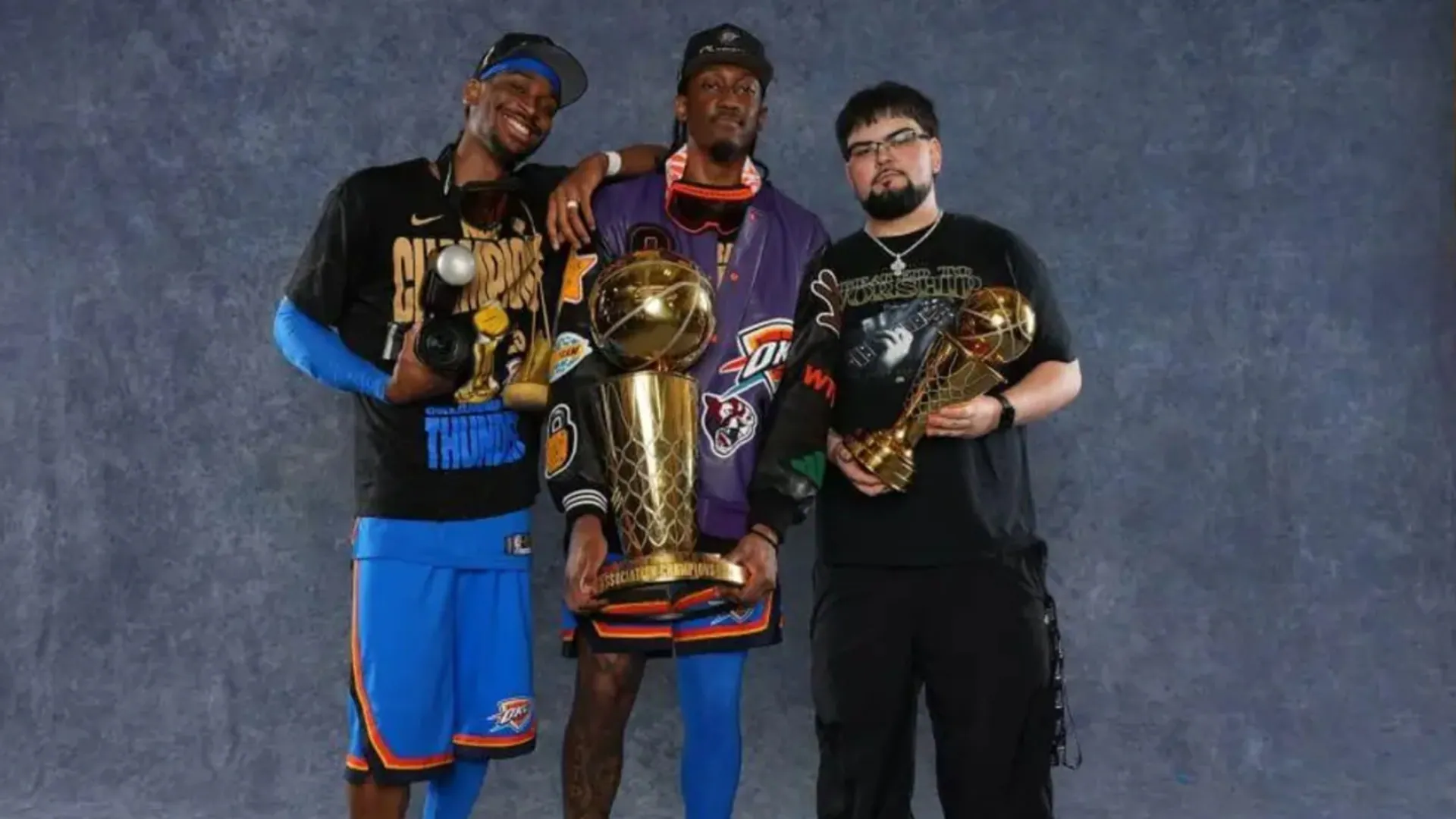

Photographer Joseph Owen Jr., right, has worked with Jalen Williams throughout the Oklahoma City Thunder forward’s NBA career.
Editor’s Note: Read more NBA coverage from The Athletic here. The views on this page do not necessarily reflect the views of the NBA or its teams.
***
Go back and watch the Oklahoma City Thunder’s 2025 NBA championship celebration. Joseph Owen Jr. is there.
Find Jalen Williams amid the confetti and champagne, and Owen is never far behind, peering through another set of lenses. Any clip, any angle, any moment: he’s always just off Williams’ shoulder. Even in the Netflix series “Starting Five,” you see him sitting next to Williams in Shai Gilgeous-Alexander’s home, getting dapped up by the MVP.
The only place you won’t see Owen is in Williams’ Instagram fit pics or YouTube vlogs, because the 21-year-old videographer is the one capturing it all.
Many NBA players have live-in chefs, trainers or personal assistants. Williams’ hired housemate is Owen, one of the league’s few live-in videographers. Owen has chronicled Williams’ rise from a rookie out of mid-major Santa Clara to an All-NBA wing. Before the accolades, before the ring, before the parade — Owen was there.
“People really need to see this stuff,” Owen said. “Everybody showing the NBA lifestyle, there’s inside info and behind the scenes that people miss out on because nobody is doing it.”
Most personal photographers around the league started filming their subjects long before they appeared on NBA broadcasts. In some cases, they have documented players’ careers since high school, and over time, they have become constants in the athletes’ lives.
“He’s family for sure,” Williams said in a text exchange. “He’s seen me at some of the highest points in my career and some of my lowest … It’s special that he has been there for moments and been able to capture moments I never thought I’d even be in.”
In the attention economy of today’s NBA, players put more effort than ever into curating online brands and personas. LeBron James, Stephen Curry and Kevin Durant founded their own production companies to tell their stories and those of other athletes. Many others around the league hire brand studios to manage their public image. In recent years, a growing number of NBA players have hired photographers to create content around their lives on and off the court in the hopes of endearing themselves to fans and generating sponsorship opportunities.
At least a dozen such personal photographers currently work with NBA players. Among the most successful are Owen, who works with Williams; Merix Alexander, who has been documenting Tyrese Maxey’s career since before the Philadelphia 76ers guard entered the league; Cameron Look, who is known as a trailblazer in the field and works with the families of LeBron James and Shaquille O’Neal; and Nick Ramos, who helped launch Jared McCain to social media fame with a YouTube docuseries while the Thunder guard was in high school.
Owen was a teenager in Sacramento when he started his career as a basketball videographer. His close friend, Isa Silva, was one of the city’s top high school prospects, and Owen began recording him on his phone. The Silva family bought Owen his first camcorder at 15; later, Owen’s mother and uncle got him a professional camera. Soon, his content became local basketball canon.
Silva introduced Owen to Bay Area player development coach Packie Turner, who allowed Owen to shoot his sessions with players like Silva. For months, Owen drove the 200-plus-mile round trip several times a week to film workouts at the coach’s training facility near San Francisco International Airport. At first, Owen worked without pay, posting content from Turner’s gym to build his portfolio. After the images and videos began to gain attention online, Turner began compensating him.
Turner recommended Owen to NBA agent Bill Duffy, who hired him to document his clients’ pre-draft workouts. That’s where Owen, who was 18 at the time, first met Williams. As Williams, Chet Holmgren and other players represented by Duffy prepared to enter the league, Owen embedded with them, documenting their on-court training and behind-the-scenes moments for up to seven hours a day. The proximity helped him form friendships with the players, especially Williams.
“We were sharing meals because we were both money tight,” Williams recalled. “We would cook the pre-made meals they gave me for workouts, split them, and just kick it all day … we liked the same stuff, especially in the creative space.”
That bond carried through the 2022 NBA Draft in Brooklyn, where the Thunder selected Williams with the 12th pick. Owen was there, flying out on one of the plane tickets the NBA provided Williams for personal use.
“I didn’t have a hotel,” Owen said. “I was sleeping on Jalen’s floor two days before the draft and the night of the draft, then left the next day.”
Owen initially moved to Oklahoma City to work for Holmgren. He lived in a small office inside the Thunder big man’s home while filming content to grow Holmgren’s brand. Still, Owen’s relationship with Williams was closer, and he spent much of his spare time at Williams’ place.
The idea of moving in with Williams arose while the two were shopping together. A friend of Holmgren’s had moved to Oklahoma City to stay with him, and Holmgren was running out of space. Owen was already filming for Williams and helping the Thunder wing with errands such as grocery shopping, package returns and airport rides.
Williams felt hesitant at first. “I didn’t want anyone to live with me, but Jojo was cool,” he said. “I was like, ‘Why not?’ As much as he was at my house, he might as well have lived there. He helped around the crib … anytime a friend can move in, it makes the experience way more fun.”
He had to advocate for it, but not long after Owen moved in, Williams agreed to put him on an informal salary. “His work deserves to be paid, pretty simple,” Williams said. “I had money for the first time in my life, so why not spread that with your friends?”
Owen’s privileged access creates some of the biggest challenges of his job. He documents Williams’ life beyond the public eye, and Williams trusts him not to reveal details that might benefit Thunder opponents. Keeping quiet about a torn wrist ligament in Williams’ shooting hand during the 2025 playoffs was hard for Owen. After games when Williams played poorly that postseason, Owen couldn’t defend his friend against criticism from NBA analysts and fans on social media.
“When the injury happened, I had to keep it a secret from everyone,” he recalled. “When (Williams) had bad games, I knew something was going on behind the scenes that nobody else knew, aside from family, and I couldn’t tell anyone.”
Like Owen, Merix Alexander, 28, entered NBA photography through relationships with skills trainers. After studying business at Louisiana Tech, he moved to Dallas and began shooting pre-draft workouts run by developmental coach Tim Martin. That connection later enabled Alexander to film one of Victor Wembanyama’s early trips to Texas. The 7-foot-4 French phenom trained with Martin in September 2022, a full season before the San Antonio Spurs selected Wembanyama first in the 2023 draft.
“First time Victor came to Dallas, I was in a gym with him,” Alexander said. “Just being there for Tim, Vic was like, ‘Oh, OK, here’s some of the first people I’m meeting here.’ Not to say he automatically trusted us. But he’s thinking, ‘OK, these are my guys.’”
On some occasions, Martin, who joined the Spurs’ coaching staff in 2025, would pay Alexander to film workouts and post content; other times, Alexander said, he worked for free to build relationships with players, shooting content to help grow his social media profile.
Maxey, one of the players Martin worked with, would eventually become among Alexander’s top clients. The two met while Maxey was preparing for the 2020 draft and they’ve worked together ever since. Alexander said that throughout their professional relationship, he has filmed Maxey at countless NBA games, workout sessions and even at Paris Fashion Week with nothing more than a handshake deal and an understanding that Maxey would pay him for the work.
“Never a contract, bro,” Alexander said. “Just trust and good faith. Everyone has paid respectfully and on time.”
Alexander said he’s sitting on more than 500 hours of footage of his clients’ lives, with an eye toward cataloging moments for future big projects. “My mindset is always, ‘This could be a movie,’” he said. “That’s always in my mind, just document it for later. We can make something work for Instagram. But the goal is long term.”
Although Alexander doesn’t typically sign employment contracts with players he works with, he said he has signed non-disclosure agreements with several clients.
Due to his working relationship with Maxey, the Sixers allow Alexander to remain in the team’s locker room and beyond the standard periods of media availability. Alexander records behind-the-scenes moments that league broadcast partners can’t, but he said he’s careful not to abuse his access and knows when to turn the camera off.
You won’t spot defensive matchups scribbled on whiteboards or eavesdrop on head coach Nick Nurse’s game plans revealed in Alexander’s videos.
Discretion is vital in this line of work.
For the NBA’s personal videographers, protecting subjects’ privacy and brand image is paramount, and perhaps no one in the profession knows this better than Cameron Look — because no one documents higher-profile families than the Southern California-based photographer.
“When it comes to working with both the James and O’Neal families, it’s a privilege to know such special people,” said Look, a go-to photographer for Bronny James and Shareef O’Neal. “Every member has their own story, their own personality. It’s a privilege to earn their trust and document them.”
Look met O’Neal while photographing a Lil Uzi Vert concert in 2017 and sparked a relationship that led him to chronicle nearly all of O’Neal’s senior high school season. At an O’Neal family gathering shortly after LeBron James joined the Lakers, Look was introduced to James’ son Bronny.
When Bronny enrolled at Sierra Canyon, Look convinced the school’s coaching staff to let him tag along as the team’s full-time photographer. He began traveling with the Blazers, camera ever-present, cultivating a relationship with Bronny that has endured into his professional career.
As Look’s business grew, he began working on ad campaigns for corporate clients, but he also remained present for the James family, continuing to photograph everything from Bronny’s games, Bryce James’ prom send-off and Zhuri James’ birthday celebrations.
“I’m always making sure they’re good, physically, emotionally, mentally — off the court and in life — before we care about building a following and putting out content,” Look said.
Shortly after he graduated from UC Irvine in 2017, Look took up street photography, shooting candid images of people at concerts and public spaces around Orange County and Los Angeles to market an online business. A lifelong basketball fan, he eventually brought his camera courtside. There was no obvious blueprint for building a social media presence by blending basketball photography and street style, but he developed a passion as he tried to capture the sport’s unpredictable and kinetic action in still images.
“I’m using the walls of the gym to create creative compositions while my subject isn’t being directed by me,” Look said. “He’s moving and just playing a game. A live-action photographer has no control over what’s happening.
“I loved getting creative and making people almost confused,” he said. “They’d see the same game, but what I posted looked completely different than what they saw.”
Look was part of the early wave of videographers who began working with NBA clients in the late 2010s. “I was a pioneer,” he said. “It’s cool to see so many people have opportunities now; it’s a multimillion-dollar business.”
Nick Ramos, a 21-year-old from Orlando, specializes in long-form footage. Initially inspired by the Netflix series “Last Chance U,” Ramos gravitated toward chronicling the experiences of elite basketball players.
“You see a different side of life,” Ramos said. “How (players) lived wasn’t the same … I feel like no one’s ever done that cinematically. It’s personal, but consistent.”
While filming a series on Rob Dillingham in 2021, when the future NBA guard was a high school junior, Ramos met Jared McCain on the AAU circuit and offered to shoot a day-in-the-life YouTube video with him during McCain’s junior year at Centennial High School in Corona, Calif.
McCain agreed. Ramos flew to California on his own dime and worked for free. Years later, McCain would pay Ramos to shoot sponsored content for brands, but at the beginning, Ramos said, “We just believed we could help each other — as my channel grew, it would help him grow, and the (money) would eventually come in ads and commercials he appeared in.” Ramos said he funded the trip with earnings from wedding photography, a paid project with former NBA wing Dwayne Bacon, and “savings from McDonald’s and Smoothie King, my first jobs.”
By 5 a.m. on his first day in California, Ramos was filming McCain’s yoga routine. That day-in-the-life video expanded into “Believe,” a documentary-style series chronicling McCain’s high school career in episodes ranging from 30 minutes to longer than an hour, amassing millions of views.
While filming three seasons of “Believe,” Ramos mostly lived in a guest room at the McCain family home. At the same time, Ramos was also filming Dillingham at Donda Academy, the now-defunct prep school founded by Kanye West, splitting time between McCain’s house and Dillingham’s dormitory in Calabasas, about two hours away from Corona.
“I’d go four days with Jared and then three days with Dillingham,” Ramos said. “The next week I’d flip it. With Rob, I’d sleep on the ground between bunk beds.”
The pace was relentless. Ramos captured behind-the-scenes moments, extended interviews and games all day, then edited through the night. A single episode could take a full week to cut, even without other commitments. There was always something new to shoot, and the edits rarely caught up.
“You’ll see past season one (of ‘Believe’), episode like four or five, I stopped putting the scenes in the early morning,” Ramos said. “I’d have to edit at night; that was the only time I had. Sometimes I wouldn’t go to sleep. One time, I was filming his early practice, and I almost collapsed and fell down from not getting any sleep too many days in a row.”
From McCain’s polished Southern California home to a nearly 35-minute YouTube documentary filmed with former five-star recruit JJ Taylor in his South Side Chicago neighborhood, where the sound of nearby gunshots occasionally interrupted the audio, Ramos embedded with his subjects, exposing viewers to starkly different realities.
“I feel like I’ve lived 100 lives,” he said. “I’ve seen so many different lives, and that’s the most rewarding thing. … People see all that. They think, ‘This is so different from this person, or even my own life.’ That’s what gets me up. It’s a new experience every time.”
Through his work with McCain and Dillingham, Ramos’ following on YouTube and social media grew, allowing him to support himself through the platforms’ advertising revenue-share programs and direct payments from users. He joked that he now makes “enough to DoorDash at least once a day and pay the bills comfortably.”
The paths Owen, Alexander, Look and Ramos took into the NBA orbit differ, as do their aesthetics. Together, they function as a bridge between what fans see on the court and what remains unseen off it as they move through the private corridors of NBA lives, carrying audiences with them.
***
Devon Henderson is a staff writer for The Athletic. He has covered the Summer Olympics, College Football Playoffs, and the Men’s Final Four while at Arizona State University and was an intern at the Southern California News Group, where he covered the Los Angeles Rams, Los Angeles Chargers, Los Angeles Sparks, and LAFC. Follow Devon on Twitter @HendersonDevon_