
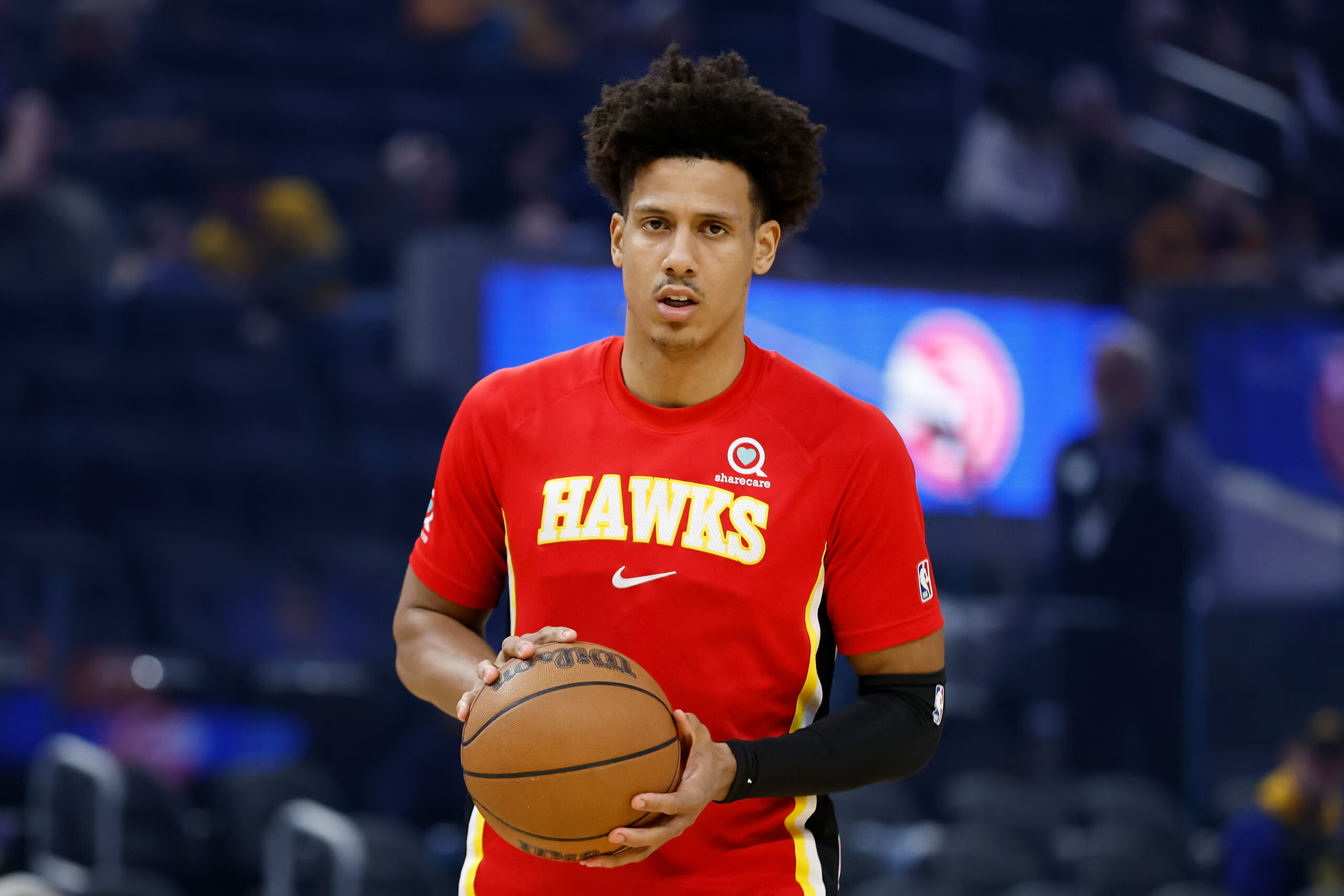

Editor’s Note: Read more NBA coverage from The Athletic here. The views on this page do not necessarily reflect the views of the NBA or its teams.
***
Each day, the onslaught of comments weighed heavier.
Jalen’s selfish.
He only cares about himself and his future NBA money.
Jalen Johnson would try to ignore them, return to the court, labor over his ballhandling or shooting. Forgetting the narratives that were building outside of the walls of the gym. But as soon as he’d leave, no matter how hard he tried, he’d see them again. Online. On TV. It felt inescapable.
He’s a quitter. He gives up on his teammates.
He can’t handle the physicality of the college game, let alone the pros.
He’s everything that’s wrong with the NCAA today.
“I just felt like the whole world was against me,” Johnson says.
It was 2021, and Johnson was a highly touted, 19-year-old Duke freshman experiencing an avalanche of social media vitriol he was unprepared to handle.
“It was kind of the first time I dealt with something like that,” he says.
Part of what ignited the uproar was that the projected NBA lottery pick had chosen to do something that few players of his caliber had: forgo his collegiate season midway through to declare for the draft. It was unexpected, especially after he had tantalized Duke fans with a monster debut against Coppin State, finishing with 19 points, 19 rebounds and four blocks. But a few weeks later, he suffered a foot injury. After missing three games, he found his way back into the lineup and regained his groove. But he was eventually moved to a bench role, and his minutes dwindled.
After 13 games, in which the 6-foot-8 forward averaged 11.2 points and 6.1 rebounds, he made his decision to sit out the rest of the season, thanking his coaches and teammates, saying he wanted to be “100% healthy in preparation for the NBA draft.”
Jalen Johnson played 13 games in his only season for Duke.
However, it felt as if the entire country no longer believed he had a bright NBA future, and, worse, that he didn’t deserve one. Strangers on the internet questioned his character, his morals. After years of being in the spotlight, in the good graces of the basketball pundits, it seemed the world had branded him with a scarlet letter — one that wouldn’t easily shake loose.
“It was a reality check,” Johnson says, reflecting on his NBA journey on a late January afternoon, when asked about the moment Jalen doesn’t become Jalen without.
It was that time period, he says, when he felt everyone was against him, everyone criticizing every aspect of who he was and who he could become, “shaped me who I am today,” he says, “and just my work ethic.” It was after that point when his journey truly began: an uphill battle to prove that he belonged in the league. To prove that he was not the person that the “narratives,” he says, said he was.
All of that feels so far away now — now that his life is radically different. Now that he is receiving adulation from all corners of the NBA stratosphere. After early years of struggle, of starting in the G League, wondering how he would ever get to where he dreamed of being, to slowly making a mark each season, Johnson has finally transformed into a star for the Atlanta Hawks and one of the NBA’s brightest talents. He took time to find his comfort on the floor — to embrace his unique path.
“Not everything’s gonna be linear all the time,” Johnson says. He had to learn to find joy in the day to day of development, even if some of those days tested him. Tested his sense of what success looks like.
Now, he’s potentially on the brink of his first All-Star appearance. He’s an NBA Most Improved Player of the Year candidate. He’s tied for second in triple-doubles this season, averaging a career-high 23.2 points. 10.5 rebounds and 8.0 assists per game. And the expectations are only rising.
“Jalen is a new face of the NBA,” says Chris Johnson, his trainer, who has also trained LeBron James, Dwyane Wade and Jimmy Butler, among others. “He’s one of those guys.”
He then takes it a step further: “I expect for him one day to be the MVP of the NBA.”
But now, he may face his biggest challenge yet: He’s been given the keys to a franchise for the first time in his career, as Hawks superstar Trae Young was traded to the Washington Wizards for CJ McCollum and Corey Kispert on Jan. 9, marking an end to an eight-year era.
Johnson, the player that many misunderstood as not being a “leader” in college, is now the one his teammates depend on and the one Atlanta management will look to build around.
“He’s that guy now,” says guard Dyson Daniels, one of his closest friends on the Hawks. “He’s brought this team together.”
Even before the trade, Johnson had been working on becoming a more vocal leader. Now, since the move, he’s made even more strides.
“It just allows me to continue to grow. It allows me to continue to build with the guys that are in the locker room right now,” Johnson says. “Trae was a great teammate and a great person to be around, but I think what we’re building right now is something pretty special. And I think that’s a fun thing.
“It’s a fun challenge and exciting challenge to look forward to — just knowing that this is just another part of the evolution of me becoming more of a leader.”
That means taking the time to pull teammates aside, individually, letting them know he’s there for them.
“I’ve started to find my voice and use it in more ways than I thought that I knew I was capable of,” Johnson says.
When Jalen speaks, on this January morning, reflecting on all he has been through, there is not a trace of regret in his voice. He is warm, introspective and open about his shortcomings earlier in his career. Now 24, he carries himself with a quiet confidence, one that can only come from questioning one’s place; from soul-searching over many moons.
He learned to trust in something his parents, Rod and Stacy, both former players themselves, told him since he was a child:
“Nothing’s going to happen overnight.”
Johnson and his Nicolet High School (Glendale, Wis.) teammates celebrate their state championship in 2019.
Rod, who played for the University of Wisconsin-Milwaukee and Southeast Missouri State University before playing professionally in Poland, and Stacy, who also played for the University of Wisconsin, taught Jalen and his brothers, Rod Jr. and Kobe, work ethic. No matter what, they could always control their effort level. That wasn’t ever an issue for Jalen, who took to the sport from a young age.
“I knew I wanted to do this for a living,” he says.
He often took the initiative and asked to practice. “Even after a hard hour and a half of working out, (Jalen) would want to keep going,” Rod says.
The family lived about a mile from an athletic club. Although all the boys were determined to play, “J would be the first one to want to get there,” Stacy says. “It was nonstop wanting to go.”
Jalen would attach a weighted parachute to himself to impede his movement in a full-court layup drill, day after day. And no matter how intense the resistance, young Jalen would trudge ahead, willing his legs to move faster, farther, to finish each layup. If he could, as a high-schooler, live in the gym, he would have gladly brought a pillow.
Jalen Johnson was the nation’s No. 4-ranked recruit coming out of high school.
That work began to show, as Johnson often competed against his brothers, all pushing each other to be better. Rod Jr. eventually played for the University of Tennessee at Chattanooga and Western Illinois, and Kobe played at USC and UCLA. Jalen had his pick of blueblood programs, choosing Duke over Kentucky, Arizona and Wisconsin. His athleticism and 7-foot wingspan set him apart, and he could make a stellar play whenever his team needed.
However, after the fallout from his freshman season at Duke, and being selected No. 20 in 2021 by the Hawks, he was quickly assigned to Atlanta’s G League affiliate, the College Park Skyhawks, given that he was behind veterans such as John Collins and Danilo Gallinari, and would have more playing time in the G League. Johnson was faced with unfamiliar territory: no longer seen as the prized recruit; the golden prospect with all the potential. He was fighting for minutes, fighting for his reputation.
And fighting with his ego.
One night, in 2021, he sat on the bench after his G League debut. He stared blankly ahead on the court. He had always felt at home when playing basketball — dribbling, zig-zagging every which way since he was a child. But on this night, the court felt anything but familiar.
He finished with six points, little resembling the dominant player he appeared to be as a five-star recruit in high school.
Why am I here? Johnson thought to himself. I’m way better.
His ego, he now says, was talking: “It was just kind of like a pride thing.” He was disappointed. In himself. His situation. The way his story was unfolding.
“I kind of looked at (the G League) like a bad thing,” he says.
Johnson was at a crossroads in his young career. He could dig deep, swallow his pride and push toward his NBA dream — or he could wallow in self-pity, pointing the finger elsewhere. He had to do what some go their whole lives without doing: look within and ask, “How can I be better? How do I need to change?”
Johnson played 20 games with the Hawks’ G League team, the College Park Skyhawks.
His ego wasn’t ready to let him answer those questions. Not yet. It felt cruel to encounter another hurdle after all he had endured in college.
“It was difficult at first,” Johnson says, especially since he was not immune to hearing others’ expectations of where they thought he should be — and how much they thought he should be playing — no matter how hard he tried to block out the noise. “You got a lot of your peers, family, anticipating you to play just because you got drafted, so there’s a lot of outside pressure.”
He’d often call his parents daily, especially his mother, for comfort — some sense of normalcy.
“Half the time the calls aren’t anything to do with basketball,” Stacy says.
Rod and Stacy reminded him that he was loved — no matter what. Their love wasn’t something he needed to earn, like playing time. It had always been that way. They never missed a game in his youth or in his high school days, and no matter how he performed or whether his team won or lost, their support never wavered. He can’t remember a moment when they weren’t there.
And on these trying nights in the G League, Stacy wanted to remind him of that: They would always be there. Stacy would remind him to take the long view. Have patience. Remember that we all have struggles — and that he would be OK.
“Even when he was at his lowest,” Stacy says, “even when he felt that he didn’t want to keep going.”
Nothing’s going to happen overnight.
Her words were a balm. Something, he knew, had to change. He finally realized: It was him.
“Once I put my pride to the side,” Johnson says, “it allowed me to truly grow and flourish and allow me to see the results of just understanding — everything happens for a reason. You’re down here for a reason.”
The G League, he now realizes, “was probably the best thing that has ever happened to me.”
Johnson began to shift his focus to what he could control, which was getting better each day.
That meant 5 a.m. workouts. Tweaking every part of his game, especially becoming a more consistent shooter. He took to heart one of his father’s favorite sayings: “It’s not what happens to you, it’s how you react.”
“He had a goal; he had a dream,” Rod says, “and he wasn’t going to stop pursuing that no matter what.”
Jalen began to let go of the timeline others expected of him.
“Everybody wants it right now. Everybody wants the microwave,” Chris Johnson says. “But nobody can take away from you when you go step by step in the process.”
Johnson said his time in the G League “was probably the best thing that has ever happened to me.”
Johnson began bonding with his G League teammates, and they started winning. But his career didn’t immediately change dramatically.
The struggle continued. And continued. And he had to keep digging deep. He kept trying to prove he belonged with the Hawks but split time between the full roster and the G League in his second season in 2022-23. No matter how little Johnson played, he felt: “I was just grateful to get that time.”
There were stretches where he’d play a few games, then get a few DNPs. Then, he’d play some games before getting another DNP. He vowed to make the most of his minutes when he did have a chance, averaging 5.6 points and 4.0 rebounds per game.
“Just keep working,” he’d tell himself.
However, when new coach Quin Snyder arrived in February 2023, Johnson’s confidence — and production — began to grow. Snyder not only believed in him but was also patient with him.
The magic began to happen when Jalen’s hard-earned patience and Snyder and the Hawks’ patience with him came together. That gave Jalen even more confidence, knowing how much his coaches were “pouring into (me),” Johnson says.
Johnson began to flourish in 2023-24, becoming one of just six players in NBA history to average at least 16 points, eight rebounds, three assists and one 3-pointer per game in a season before turning 23.
“Once I started seeing more steps in the right direction,” Johnson says, “it just made me more hungry because I know I wasn’t done or nowhere near where I wanted to get to.”
The Hawks rewarded him with a five-year, $150 million contract extension in October 2024. And even then, he was still often the first to arrive to shoot before games, even at night on non-game days on the road.
“When you see one of your best players put in a lot of time, it makes young players and other guys on the team want to do the same thing,” says big man Onyeka Okongwu, another close friend on the team.
“He just plays the basketball the right way,” Okongwu adds.
Last season, Jalen had a breakout campaign, averaging 18.9 points, 10 rebounds and five assists, but he ended the season with a torn labrum injury.
After recovering from surgery, Johnson spent part of the summer working out with James, pushing himself to learn and study from someone he has long admired. He labored on his weaknesses, putting himself through two to three workouts per day. His trainer doesn’t remember him taking time off during the All-Star break in the last four years.
Johnson signed a five-year, $150 million extension with the Hawks in October 2024.
Johnson’s circle won’t let him forget how far he’s come. Chris often reminds him about those dark days, when his name wasn’t in All-Star conversations. When many didn’t believe in him. And in turn, Johnson remembers how those struggles taught him gratitude and to appreciate his journey more.
Maybe if he had the traditional top-pick path, and everything went smoothly, he wouldn’t have the same desire or discipline. Perhaps if he hadn’t played in the G League, he wouldn’t have the same humility or maturity. Or the same joy for the mundane drills that make a big difference.
CAREER NIGHT FOR JALEN JOHNSON!
🔥 41 PTS (career-high)🔥 14 REB🔥 7 AST🔥 4 3PM
He leads the Hawks to the double OT victory. pic.twitter.com/RsHFwoQdAs
— NBA (@NBA) December 1, 2025
There are times he feels this gratitude most, such as a close game against Philadelphia in late November. With 4.6 seconds remaining in overtime, Tyrese Maxey missed two free throws. Johnson then caught the ball and drove hard to the basket. He was fouled with 0.3 seconds remaining.
Philadelphia 76ers coach Nick Nurse called a timeout to ice Johnson. But Johnson didn’t waver, looking as calm as ever, stepping to the line. He sank both free throws to force a second overtime.
“It was kind of a surreal moment,” says Johnson, who finished with a career-high 41 points, 14 rebounds and seven assists to help his team win.
He had long dreamed of that moment, standing at the free-throw line with everything and everyone depending on him. And it hit him, with remarkable clarity, hours later, when he was finally alone that night. The screaming fans, now mute; the arena lights, long gone. He could finally see it all. Everything he had endured, everything he wanted to become.
We’re here now, he thought to himself. We’re here.
***
Mirin Fader is a senior writer for The Athletic, writing long-form features, primarily on the NBA. Mirin is also the New York Times best-selling author of GIANNIS: The Improbable Rise of an NBA Champion and DREAM: The Life and Legacy of Hakeem Olajuwon. She has told compelling human-interest features on some of our most complex, most dominant heroes from the NBA, NFL, WNBA and NCAA, most recently at The Ringer. Her work has been featured in the Best American Sports Writing books. She lives in Los Angeles. Follow Mirin on Twitter @MirinFader