

Editor’s Note: Read more NBA coverage from The Athletic here. The views on this page do not necessarily reflect the views of the NBA or its teams.
***
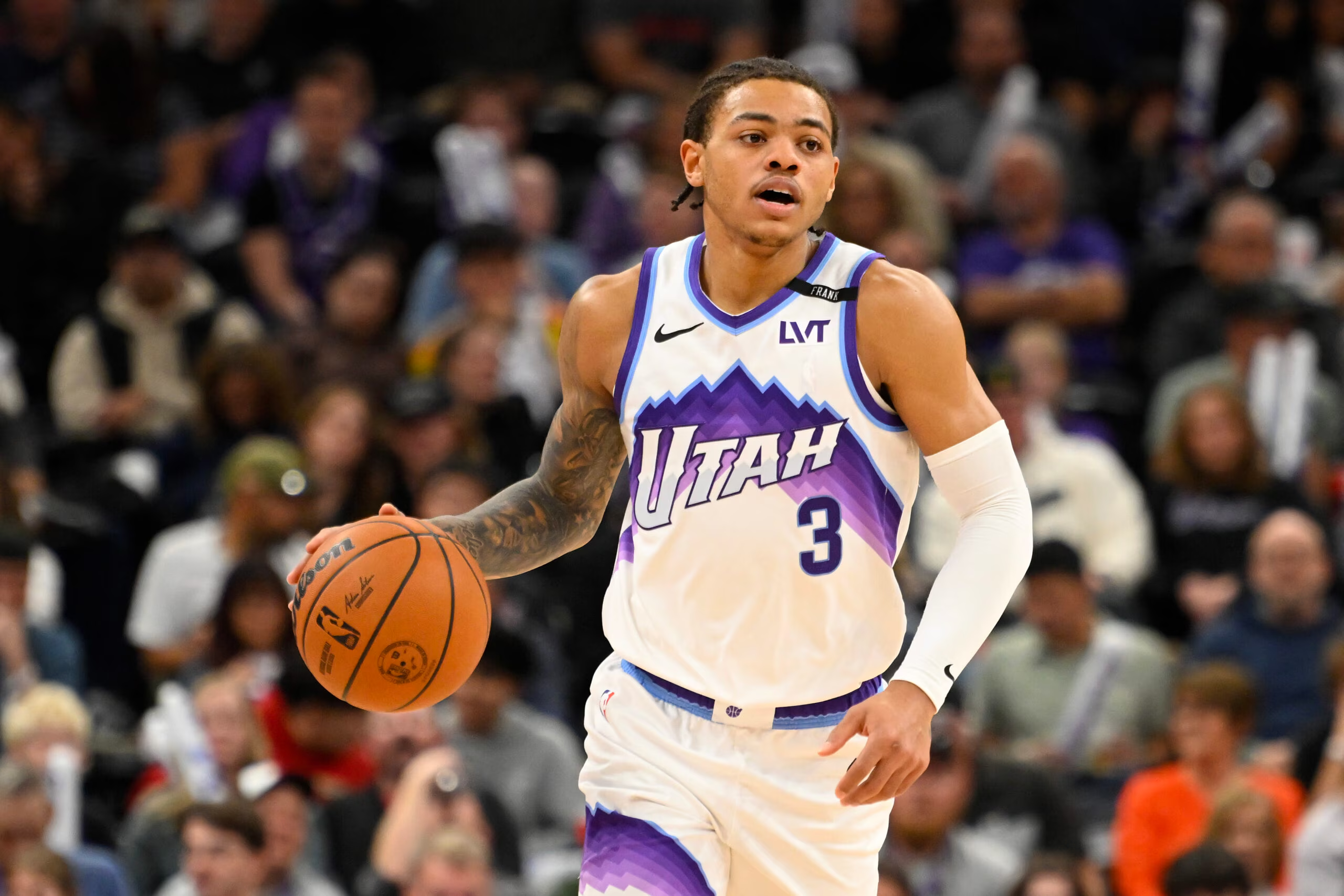
Keyonte George didn’t know what to expect when he made his way to Finland.
At the time, all he knew was that he needed to understand Lauri Markkanen better. He knew that he needed to figure out a way to take some leadership responsibility with the Utah Jazz, even if he was barely old enough to drink. He knew that a rookie season that had some real highs and lows needed improvement. And George and Markkanen both knew they needed to figure a pathway to better chemistry when they were on the court together.
Players as young as George typically don’t have the kind of self-awareness it requires to make moves like this. But, George, even for some of his faults, has always been mature and thoughtful. More importantly, he’s always been serious about his craft. It’s one of the reasons why the Jazz latched onto him and drafted him.
“For me, it was just looking at some of the best teams and knowing that their top guys have a connection,” George told The Athletic. “I always wanted to travel the world, and I wanted to show Lauri that, hey, I’m going to come to you. I want to see you in your comfort zone. I wanted to build that relationship. I wanted to show him that I actually care about him.”
During that trip, Markkanen showed George where he went to school. They got some time on the court together, as the Jazz sent prized skill development assistant Chris Jones on the trip. George got to see Markkanen interact with his family and the people that are close to him. But one conversation stood out among most.
Markkanen took George to the gym where he gets his weightlifting in. The two walked in, and Markkanen saw someone he had been friendly with. The two got into small-talk, and that evolved into jokes and laughter, which included Markkanen showcasing a dry humor he is known for by the people closest to him. George watched, and he remembered thinking the following: “This isn’t the guy that I’ve been playing with.”
It’s not like Markkanen doesn’t have a personality or a comedic side. He does. But George is a kid from Texas. At the time of this trip, he had played his high school basketball. He had played a year at Baylor, and he had just finished his rookie season with the Jazz. Most who know George would describe him as a basketball junkie, and someone who is serious at his craft. The same could be said for Markkanen.
Woke up in Helsinki 🇫🇮👀🔑#TakeNote pic.twitter.com/ijvpA2DZ2t
— Utah Jazz (@utahjazz) July 29, 2024
With the two being a solid six years apart in age, they simply didn’t interact much off the court. So, there was some mystery with both as to whom the other was dealing with. And that couldn’t persist. Markkanen, from the moment he was traded to the Jazz, has been one of the most dynamic combination forwards in the league. He’s one of the blocks the Jazz want to build around, no matter how many times his name is put into trade rumors. George became a starting point guard as a rookie, was benched as a sophomore, and, in his third year, has been so good that he has to be on the short list of most improved players in the league.
The Finland trip may have been brief, but the effect has been lasting. Markkanen and George became more than co-workers on that trip. They built a friendship.
“I will always give Keyonte credit,” Markkanen told The Athletic. “He’s one of the first people to come to Finland and see where I’m from, and where I come from and how I’m living. I didn’t know whether it was if he wanted to understand me better, or not. But, it was really cool to see him reach out to me in that way. And it’s been really cool to see how our relationship has gone over the last year. We’re hanging out more off the court. We listen to each other on the court. And you’re seeing the results on the floor.”
The trip became a relationship starter for a star 7-footer in a lead role for the first time in his career, and a sometimes moody rookie who has blossomed into one of the most improved players in the NBA by his third year. It also became the building block for a head coach that needed credibility with his players.
“It’s time to grow up.”
As George watched Jazz coach Will Hardy mouth those words during an exit interview at the end of last season, George realized that his coach was correct. He knew that, at the tender age of 21, his career was already at a crossroads. Think about it. Hardy had already benched him for a — and this is putting it mildly — lack of defensive awareness. And, with a lottery pick coming up, there was the possibility of the Jazz just going ahead and drafting over him.
But, Hardy is the kind of coach who is hard on you because he cares about you. In some odd way, him benching George wasn’t a demotion. It was a show of confidence. It was Hardy saying: I know you are a better player than this. I know you can do better than this. I am not going to play you, unless you show effort on the defensive end.
Hardy knew that he was walking a thin line. He wanted to get the best out of George, but he also wanted to be honest with him. So, he chose the direct approach.
“I remember the conversation being very difficult, because I love that kid,” Hardy told The Athletic. “I love him, and I believe in him. By nature, telling people things they don’t want to hear isn’t easy. Being brutally honest isn’t always easy. I had to trust in that moment that the trust we had already built could sustain what I was saying to him. It was a real heart-to-heart. I wanted to be honest about where I felt he was. I wanted to build from the truth.”
Jazz coach Will Hardy talks with guard Keyonte George during a game against the Kings.
George took Hardy’s words to heart. His superpower as a player has always been his ability to score. He can make shots in a number of ways. But he was a tweener: not quite a point guard, not quite a shooting guard. He was inefficient. He turned the ball over too much. And he was prone at times to bad body language. This season, he’s been a leader and has put it all together as a player
The rumblings of his improvements began circulating midway through the summer. A team source told The Athletic that he was the “MVP” of the offseason. And George had some fun with it. He immersed himself into the community. He became one of the first Jazz players in years to go and play in the Powder League Pro-Am summer league that local college and pro players play in. He embraced Utah, while consistently grinding in the practice facility every day.
Building a team organically from the ashes takes time … and sometimes it can take a lot of time. A circle of trust between George, Markkanen and Hardy hasn’t been easy to attain. There have been difficult conversations. There have been disagreements. There has been some immaturity. There have been a few come-to-Jesus moments. But, the Jazz are trying to build something, for the first time since Donovan Mitchell and Rudy Gobert era, during which Utah had the NBA’s fourth-highest win percentage (.623 from 2017-18 to 2021-22). They aren’t close to where they want to be, especially in a rugged Western Conference.
As a coach, Hardy needing buy-in from his two best players has been the foundation to him being able to coach the remainder of the roster. If the Jazz can sit down in a film session and see George and Markkanen getting coached hard, then Hardy should be able to coach the rest of the group the same way.
It’s the same thing that Hardy saw from his mentor, Gregg Popovich, when he used to light up Tim Duncan. If you go back, it’s the same thing Pat Riley used to do to Magic Johnson and Kareem Abdul-Jabbar. The friendship that Hardy has built with his players can be summed up in a group chat the three have that gets used constantly.
Of course, this reporter asked the name of the chat.
“None of your business,” Hardy said, with a laugh.
And then, as Hardy does, he got serious.
“Trust is hard to gain, and I’m a young head coach who is growing with our team,” Hardy said. “I’ve grown a lot with those guys. I’ve had some good moments, and I’ve had some hard moments. The fact that I know that I have their trust means a lot to me. Credibility in the locker room is hard to gain. I’ve put a lot into our relationship, and so have they.”
Hardy is being effusive in his praise, but the reality is this: He deserves a ton of credit for the maturation of both Markkanen and George.
Markkanen was used completely wrong with the Chicago Bulls. And that contributed to frustration and malaise, the Bulls eventually giving up on the relationship and Markkanen ending up in Cleveland with the Cavaliers. The Cavs put Markkanen in better spots, and were the first team to realize that he was capable of being a hybrid forward and living completely on the perimeter. But, he was still more of a spot-up shooter than anything else.
When Markkanen was included in the Mitchell trade, Hardy had already watched him. But he didn’t watch Markkanen’s minutes. He watched his Finland national team film. He watched how Markkanen was unleashed and drew up an offense that did the same thing. Defending Markkanen these days is like dealing with a great utility running back. You never know where he is going to line up.
Markkanen is a special player, as a 7-footer who is a volume and movement 3-point shooter, but also a threat above the rim. He’s averaging 28 points per game while pulling down over six rebounds per game. He’s difficult to guard because he moves extremely well without the ball. Hardy’s offense gets him on the move at all three levels, and he’s someone who has a short memory. A string of missed shots doesn’t phase him. He’s always going to be aggressive offensively. Being a three-level scorer at his size, and in his prime, is one of the reasons he’s been so coveted on the trade market. But the Jazz have repeatedly sent signals that they want him on the next Utah team that’s actually good.
On one possession, Markkanen can be in pick-and-roll, setting the screen. On another, he could be the ballhandler in the action. On another, he can be posting up. On another, he’s running off multiple screens. He’s similar to Dirk Nowitzki in the way he’s able to impact a game offensive as a big who doesn’t dribble the air out of the ball. His hard work and Hardy’s schemes have turned him into one of the most versatile offensive talents in the league.
It’s one of the reasons, financial riches aside, that Markkanen decided to give a long-term commitment to Utah. He found a coach that unlocked him. And that went a long way with him.
“It would mean a lot to see this rebuild through,” Markkanen said. “For me, the journey of getting better and better as a team and then finally breaking through means a lot to me. I would love to be a part of the next great Jazz team. Being from Finland, not much is expected from our national team. So, I want to put hoops on the map there. I have that same mindset here as well. I want to get better as an individual and as a team.”
George spent his youth as one of the most coveted basketball players in America. And, like most McDonald’s All-American types, you are talking about a kid who hasn’t been held that accountable in basketball over his youth. That was the jarring thing about his benching: It’s never happened to him before.
He reacted by having long talks with his mother, Kristen. Their first order of business?
The body-language thing.
“Fix your face,” Kristen George would often text her son during games, which he would read at halftime. “Fix your energy.”
She made sure to tell him to stay professional, and to get something out of being benched.
“You have to give kudos to the people in my circle,” George said. “I made sure that I came into games with high energy. I would sprint to the scorers table. It was the first time in my life I had been benched, so I had to figure out how to make it a positive experience.”
“My mom will always be my mom. So, when words are coming from her, it’s different than coming from coach. She’s being supportive, and it’s something that I know I can always turn to.”
When you watch George play this season, the maturation is clear. He makes better reads out of pick-and-rolls than he ever did. He is running the Jazz, and slowly figuring out the balance between getting others involved and seeking out his own offense. His shotmaking has always been there. But, now he’s more efficient at getting to the free-throw line. He’s become one of the better point guards in the league.
Two players and one head coach are giving Utah blocks with which to build. And the Jazz (7-13) are not completely back, but they are getting closer. They have been more competitive this season. They have been fun to watch. And they have the assets in place to keep building.
“Ultimately, I think we are improving,” Hardy said. “I think we are doing the right things, and trying to set a culture that we can rely on every day. I think people around the league can see that. We have an incredible organization and an incredible fan base. We have a chance to do some great things.”
***
Tony Jones is a Staff Writer at The Athletic covering the Philadelphia 76ers and the NBA. A native of the East Coast and a journalism brat as a child, he has an addiction to hip-hop music and pickup basketball, and his Twitter page has been used for occasional debates concerning Biggie and Tupac. Follow Tony on Twitter @Tjonesonthenba